Tuesday, 7 January 2025

Nicco and Associated Companies Senior Management Superannuation Fund Vs. Vinod Kumar Kothari (Liquidator) - Thus, as long as there is an existence of a fund by whatever name it is called which is for the use of the employee in future i.e. Provident fund or Superannuation fund, it is the workers’/employees’ money held in trust by the employer and as such can not form a part of the liquidation estate.

 NCLT Kolkata (2024.12.18) in Nicco and Associated Companies Senior Management Superannuation Fund Vs. Vinod Kumar Kothari (Liquidator) [(2024) ibclaw.in 1186 NCLT, I.A. (I.B.C) No. 424/KB/2020 in C.A.(I.B.) No. 788/KB/2019 in C.P.(I.B.) No. 03/KB/2017] held that;

  • Thus, as long as there is an existence of a fund by whatever name it is called which is for the use of the employee in future i.e. Provident fund or Superannuation fund, it is the workers’/employees’ money held in trust by the employer and as such can not form a part of the liquidation estate.

  • Next, we come to the issue of the amount of money to be deposited which has been variously represented. The liquidator is hereby directed to calculate the amount in keeping the rules of the superannuation scheme/fund, up to the date of the liquidation and deposit the amount in the fund.


Excerpts of the Order;

# 1. The present application has been filed by Nicco and Associated Companies Senior Management Superannuation Fund (Applicant) under Section 60(5) of the Insolvency and Bankruptcy Code 2016 read with Rule 11 of the National Company Law Tribunal Rules, 2016 seeking the following reliefs: 

  • (a) That directions be served upon the Respondent Liquidator appointed by this Hon’ble Tribunal to pay a sum of INR.50,99,000/- to the applicant trust;

  • (b) That directions be served upon the Respondent Liquidator to pay a sum of INR. 5,00,000/- to the Applicant Trust towards legal cost incurred;

  • (c) Ad-interim orders in terms of the prayers above;

  • (d) Such or other order or orders be made and/or directions be given as to this Hon’ble Tribunal may deem fit and proper.

.

Facts of the case:

# 2. An application being C.A. (I.B) No. 788/KB/2019 was moved on 02.07.2019 which after being heard by this Adjudicating Authority was disposed of vide order dated 04.10.20191, however the order failed to record the quantum of superannuation dues. Thereafter an amendment application being C.A. (I.B) No. 1668/KB/2019 was filed in C.A. (I.B) No. 788/KB/2019 praying that the superannuation quantum being Rs. 50,99,000/- be included in the letter and spirit of the order dated 04.10.2019. After hearing the same, this Adjudicating Authority disposed of the same vide order dated 10.10.20192 in which it was recorded:

  • "C.A. (IB) No.1668/KB/2019 is an application filed by the workmen seeking certain clarification in the order dated 04/10/2019 passed by this bench. Being satisfied with the submissions submitted on both sides we find there is an inadvertent omission in respect of superannuation fund to the tune of Rs.50.99 Lakhs. Accordingly, the amount is to be included in the order and an amended order is to be uploaded forthwith.

  • Ld. Liquidator is directed to distribute it in accordance with the order dated 04/10/2019 and subject to the eligibility of the beneficiary for which the list of beneficiaries is to be submitted by the applicant to the Liquidator. Accordingly, this CA is disposed of."


# 3. The applicant stated that the quantum deposited with the applicant trust was not directly transferred to the beneficiary but the same was transferred to Life Insurance Corporation of India (LIC) which in turn would pay the employees after considering their eligibility.


# 4. The Respondent i.e., the Liquidator in his draft order dated 20.01.20203 stated that the superannuation fund is not pursuant to any statutory obligation as under the EPF Act and the same cannot be said to be similar to pension funds as stipulated under EPF Act, since the arrangement is purely voluntary and solely for the benefit of certain classes of employees.


# 5. It is also stated that the Liquidator in case of a similar funds has accepted payment of shortfall before the waterfall mechanism which pertains to Nicco Restructuring Employees Trust Fund (NRETF), a voluntary and non- statutory trust fund whose claim of Rs.34,55,000 was settled by the Liquidator. Further, the books of accounts of the Corporate Debtor as on 13.10.20174 also noted such obligation of payment of superannuation fund. 


# 6. The Liquidator in his written submission accepted the fact that the claim of superannuation due has to be considered in the same manner in which the gratuity dues were being discharged. The Liquidator has erred in putting the trust’s claim through the waterfall mechanism as envisaged under Section 53 of the Code. This act of the Liquidator of not disbursing the due amount to the applicant trust is causing undue hardship to the applicant trust and its beneficiary and such delay is causing immense financial hardship and difficulties since the beneficiary does not have any alternative source of income as their livelihood as stopped after the order dated 17.10.2017 from when they had been discharged from the services of the Corporate Debtor. 


Contents of the Reply Affidavit filed by the Respondent/Liquidator:

# 7. The Respondent received a letter dated 07.03.2019 from the applicant reiterating that the claimed amount falls under Section 36(4)(a)(iii) of IBC and that there was a variation of claim from Rs.1,08,88,875/- to Rs.50,99,000/-. As per the applicant, the claim was originally filed for 3 beneficiaries out of which 2 were dealt with in accordance with share purchase agreement with Oriental Nicco and therefore the claim was reduced to Rs.50,99,000/- with respect to shortfall in the Fund, and the only beneficiary was Mr. Kartick Chatterjee who is also one of the trustees and Ex-Managing Director of the Corporate Debtor.


# 8. The Respondent also stated that the Applicant’s reliance on the judgment of NCLT, Mumbai Bench in Asset Reconstruction Company (India) Ltd v. Precision Fasteners Ltd (MA 576 & 572 of 2018 in CP (IB) No. 1339/MB/2017) and judgment of Alchemist Asset Reconstruction Co Ltd v. Moser Baer India Limited (CA-19 (PB)/2019) wherein the Benches held that pension fund dues are not treated as part of the liquidation estate and would not therefore be recovered by section 53 of IBC, 2016. 


# 9. The Respondent had repeatedly sought for certain information/documents but the applicant preferred to file an application being CA No. 788/KB/2019 claiming superannuation dues beyond the priority of Section 53 but did not provide the Respondent with the required documents. After the orders dated 04.10.2019 and 10.10.2019 passed by this Adjudicating Authority, in order to determine the eligibility of the Applicant when the Respondent asked for some documents, the only document provided was a copy of one LIC policy. It was also not clear from the policy whether the Fund is a statutory or voluntary fund. However, on 16th January, 2020, the Respondent received a copy of the trust deed, scheme document and text of related rules from which it appeared that the fund has been constituted for making voluntary contributions from the Group Companies for the benefit of senior employees. The contributions from such companies go to the LIC and then the LIC makes payment of superannuation dues to the concerned employee. 


# 10. The following conclusion was made out by the Liquidator upon perusal of the required documents:

  • a. The Fund claimed was not pursuant to any statutory obligation as under the EPF Act. Hence the arrangement is purely voluntarily and solely for the benefit of certain classes of employees (senior management and employees) and cannot be compared with statutorily required gratuity/provident/pension funds as referred to in the Code. There was no deduction from the salary of the employee as well. As such, the superannuation fund is merely an obligation from the employer, which cannot be regarded as any different from the rest of the employers' obligations to the employee. 

  • b. the members of the scheme were to be paid out of the balance lying in the Fund only, and the participation of a company could be discontinued on account of financial adversities.

  • c. it cannot be contended that the obligation to make payment to the Superannuation Fund is covered by section 36(4)(a), as not being part of the liquidation estate and therefore, as per the Liquidator, the Claimant is not eligible for disbursement of funds beyond section 53 of the Code.


# 11. The decision mentioned above was communicated via an email dated 20.01.2020 which was disregarded by the applicant stating that the said draft decision goes against the order of this Adjudicating Authority to which the Respondent clarified his stand on the draft decision vide email dated 29.01.2020 which has been omitted by the applicant in the present

application. However, as no comments were given by the applicant on the issues/points involved till 28.01.2020, the Respondent treated this as a final decision and communicated the same to the applicant vide email dated 29.01.2020.


# 12. The Respondent stated that it is clear that the Code, vide section 53, accords higher priority to workmen dues over employee dues. Voluntary arrangements entailing creation of trusts in favour of senior management, if taken to be beyond section 53, would go on to circumscribe the basic fabric of the Code. Therefore, it is counter-intuitive to say that when section 53 calls for payment of wages to workmen in accordance with the priority, the dues to senior management be paid off beyond the said priority any such interpretation goes against the spirit of welfare laws read with the provisions of the Code. It is submitted that the ruling in Moser Baer was to enhance a social security measure and not to take away the part available to workmen and redirect the same to senior employees.


# 13. With respect to sub-para (xviii) of para 6, the Applicant is drawing incomparable reference to NRETF, wherein the sums were deducted from  the salaries of the employees but were not remitted to NRETF. In essence, the amount required to be remitted to NRETF was the money of the employee and not the Corporate Debtor. it is hereby clarified that the Respondent has only released the amount due to the Trust Fund based solely on the fact that, such amount was deducted by the Corporate Debtor from the salaries of the employees and the same was owed to the employees outside the liquidation estate. However, as clarified above, there is no such case of 'deduction' from employees’ salaries for onward contribution to any Fund in case of superannuation dues.


# 14. The Respondent also stated that the contention of the applicant that the books of accounts of the Corporate Debtor also mentions about the superannuation dues due to the applicant is not correct. The balance sheet of the Corporate Debtor reflect the superannuation fund under the head ‘short term provision’ but nothing regarding past contribution, remaining balance and the shortfall has been provided therein which clearly gives a strong doubt on the pre- existence of the fund and in any event a mere balance sheet entry of a liability cannot be a ground to disburse the amount against the provisions of the Code.


# 15. The Respondent has contended that it is not true that the act of the Respondent is causing any injustice to the Trust as the Respondent cannot divert money lying in the liquidation estate towards himself and leave behind the workmen and other employees of the Corporate Debtor. Therefore, this application is liable to be dismissed. 


Contents of the Supplementary Affidavit filed by the Applicant 

# 16. The superannuation dues as claimed by the applicant in the application is Rs.50,99,000/- as calculated up to 17.10.2017. However, on 03.01.2017, the LIC had communicated to the Applicant that considering that since Mr. Kartick Kumar Chatterjee is entitled to monthly pension Rs. 36,800/- from November, 2017 itself, the 5 years arrears from October 2017 to December 2022, amounting to Rs. 23,18,400/- also needs to be contributed by the CD Liquidator to the Applicant Trust Fund and in turn to the LIC to enable LIC to start the monthly pension outflow to the said Mr. Kartick Kumar Chatterjee. Therefore, the total amount of contribution that needs to be made by the Applicant Trust to LIC for the superannuation of Mr. Kartick Kumar Chatterjee as on January 2023 was Rs. 72,85,779/-. For this, the Applicant made a supplementary affidavit filed on 15th March 2024 to bring in record the communication of LIC dated 3rd January 2024 and also prayed for modifications of the prayer in the instant IA and modification in the amount of contribution required to be done by the Liquidator to the Applicant Trust.


# 17. Subsequently, the Applicant Trust received a communication by LIC that the as on June 2024, the arrears from October 2017 till June 2024 amounting to Rs. 29,44,000/- needs to be contributed by the CD Liquidator to the Applicant Trust Fund and in turn to the LIC to enable LIC to start the monthly pension outflow to the said Mr. Kartick Kumar Chatterjee. Therefore, the total amount that needs to be paid is Rs. 73,98,586/- and not Rs.50,99,000/- which was due as on 17.10.2017. 


# 18. Therefore, this supplementary Affidavit has been filed to bring on record the aforesaid facts and the modifications of the prayer of the instant application and the modification in the amount of contribution that is now required to be done by the Respondent to the Applicant Trust.


Analysis

# 19. Heard the counsels on both the sides.


# 20. The provision of the law governing the issue is contained in Section 36(4)(a)(iii), which reads as under:

  • “ (4) The following shall not be included in the liquidation estate assets and shall not be used for recovery in the liquidation:—

  • (a) assets owned by a third party which are in possession of the corporate debtor,including— 

  • (i) assets held in trust for any third party;

  • (ii) bailment contracts; 

  • (iii) all sums due to any workman or employee from the provident fund, the pension fund and the gratuity fund;

  • (iv) other contractual arrangements which do not stipulate transfer of title but only use of the assets; and

  • (v) such other assets as may be notified by the Central Government in consultation with any financial sector regulator; 


# 21. It is clear that the pension fund is exempted from being considered to be forming a part of the Liquidation estate and the genre of the Superannuation fund is similar to a Pension fund. It is not the matter as to whether the scheme is voluntary or compulsory, since the money that would have been deposited in the fund would come from the workmen or employees account only. In cases where the employees would not opt for being a part of such a superannuation scheme would naturally get the equal or equivalent amount along with their salaries to keep them at par with those who do , in whose case i.e. those who would opt for the scheme, this money would be deposited in the superannuation fund. In either case the employer’s liability is established and the contribution of the employees whether directly or indirectly would not form a part of the liquidation estate. We therefore do not agree to the submission of the respondent liquidator that no parallels can be drawn with the contribution made to the NRETF, as in the instant case no money was deducted from the salary of the employee. Thus, as long as there is an existence of a fund by whatever name it is called which is for the use of the employee in future i.e. Provident fund or Superannuation fund, it is the workers’/employees’ money held in trust by the employer and as such can not form a part of the liquidation estate.


# 22. Next, we come to the issue of the amount of money to be deposited which has been variously represented. The liquidator is hereby directed to calculate the amount in keeping the rules of the superannuation scheme/fund, up to the date of the liquidation and deposit the amount in the fund. The amount of pension that would result would be accordingly re-calculated by the fund manager/LIC.


# 23. I.A. (I.B.C) No. 424/KB/2024 is allowed in above terms and disposed of.


# 24. A certified copy of this order may be issued, if applied for, upon compliance with all requisites.

----------------------------------------


Thursday, 2 January 2025

Mr. Mukesh Verma RP Vs. Mr. Markand Adhikari & others. - As above facts clearly clearly lead to a conclusion that the business of the Corporate Debtor was carried with an intent to defraud creditors by creating a bogey of the acquisition of content to avail disbursement of sanctioned facilities.

 NCLT Mumbai-1 (2024.12.17) in Mr. Mukesh Verma RP Vs. Mr. Markand Adhikari & others. [I.A. 1464 OF 2021 in C.P.(IB) No. 2731/MB/2019] held that;

  • In question, we have no hesitation to say that these transactions were undertaken to defraud the creditors of the Corporate Debtor by mis-appropriating the loan availed from lenders under the garb of acquisition of content for launching of two new channels.

  • As above facts clearly clearly lead to a conclusion that the business of the Corporate Debtor was carried with an intent to defraud creditors by creating a bogey of the acquisition of content to avail disbursement of sanctioned facilities.


Blogger’s Comments; Adjudicating Authority’s observations as above in the teeth of the following audit observations are quite interesting.

  • “the valuation of inventory / intangible assets and its marketability / valuation holds the key to our conclusion. If these assets are able to generate the revenues which the Corporate Debtor has paid for (except variation on account of efflux of time) then the transactions although with related parties could be considered genuine.” 


The above observations suggest existence of inventory / intangible assets  so acquired by the CD with the help of credit facilities provided by the banks & the only question remains is that of the valuation of the said inventory/intangible assets, resultantly their classification as undervalued transactions, with a look back period of two years (Transactions entered with related parties). 


SCI (2010.09.08) in M/s Kranti Asso. Pvt. Ltd. & Anr vs Masood Ahmed Khan & Ors [CIVIL APPEAL NO._____ OF 2010 (Arising out of SLP (C) NO.12766 OF 2008)]held that; 

  • # 51(n). Since the requirement to record reasons emanates from the broad doctrine of fairness in decision making, the said requirement is now virtually a component of human rights and was considered part  of Strasbourg Jurisprudence. See (1994) 19 EHRR 553, at 562 para 29 and Anya vs. University of Oxford, 2001 EWCA Civ 405, wherein the Court referred to Article 6 of European Convention of Human Rights which requires, "adequate and intelligent reasons must be given for judicial decisions".


Excerpts of the Order;

# 1. This Application I.A. 1464/2021 is filed by Mr. Mukesh Verma (Resolution Professional) on 07.06.2021 under Section 60(5) r/w Section 49, 66 and 69 of the Insolvency and Bankruptcy Code, 2016 (Code) against Mr. Markand Adhikari and Others (Respondents) in the Corporate Insolvency Resolution Process (CIRP) of SAB Global Entertainment Media Pvt. Ltd. (Corporate Debtor) seeking following reliefs

  • a) Be pleased to declare aforesaid transactions as done by Respondent No. 1 to 12, as fraudulent transactions under section 49, 66 and 69 of the Code.

  • b) Be pleased to direct the Respondent No. 1 & 2 to return the amount of Rs.133,14,85,175 (Rupees One Hundred Thirty Three Crore Fourteen Lakh Eighty Five Thousand One Hundred Seventy Five Only only, being the amount of admitted claims of the two secured Creditors since the entire amount of loan obtained was diverted and the public money was utilized by the Respondent No. 1 and 2 for unknown purposes;

  • c) Be pleased to direct the Respondent No. 12 to return the amount of Rs.84.91.600 (Rupees Eighty Four Lakh Ninety One Thousand Six Hundred Only) only, plus interest as per MSMED Act from 25 March 2017 till date, being the amount of preferential treatment accorded to Tanish Entertainment. 

  • d) Alternatively, be pleased to appoint an appropriate body to investigate into the affairs of the Corporate Debtor, Respondent Companies and t e Adhikari Group Companies in order to lift the Corporate Veil and punish the person responsible for all these transactions.

  • e) For such other and further reliefs as this Hon’ble Tribunal deems fit and necessary.

  • f) For the cost of this Application.


# 2. The application for commencement for Corporate Insolvency Resolution Process (CIRP") was filed by Punjab National Bank under section 7 of the Insolvency and Bankruptcy Code, 2016 ("Code") and the same was admitted by this Tribunal vide order dated 05th November 2019 passed in the above captioned Petition, wherein the Applicant was appointed as Interim Resolution Professional (IRP") and was directed to take necessary steps in accordance with the relevant provisions of the Code and its respective regulations.


# 3. Consequent to twice publication of FORM G, no Resolution Plan was received and the Corporate Debtor was resolved to be liquidated by CoC on 5th CoC meeting held on 10.8.2020.


# 4. The Applicant as the Resolution Professional, appointed M/s. Mehta, Singhvi & Associates, Chartered Accountants ("Transaction Review Auditors"), to conduct the transaction review for the Corporate Debtor for the period current year 2019- 20 and two completed years prior to the same ("Transaction Review Report"). The Transaction Review Auditor analyzed various records of the Corporate Debtor such as financial and bank statements, documents, details of potentially related parties, etc. as made available by the Corporate Debtor. The Transaction Review Auditors have relied on the data made available by the Applicant,  representatives of the Corporate Debtor, the banks, and the online records of the Ministry of Corporate Affairs. A mere perusal of the said transaction audit report highlights various transactions which were found to be suspicious. The Transaction Auditor, provided a detailed list of observations, along with the documents required to clarify the observations, to the Suspended Directors. The Respondents, had replied to the said Letter of the Applicant and provided their response to the transactions found suspicious in the forensic audit. The Respondent No.1 Mr. Markand Navnitlal Adhikari, is the promoter and director of the Corporate Debtor, as on date of commencement of CIRP, the Respondent: No. 1 held 1,81,17,500 shares, whereas Late Mr. Gautam Adhikari held 1,68,82,500 shares. The Respondent No.2, Latasha Laxman Jadhav, is the director of the Corporate Debtor. as on date of commencement of CIRP.


# 5. The Applicant states that the Respondent Nos. 1 & 2 have been impleaded herein as parties as they are responsible for downfall of the Corporate Debtor and their current directorship in the related party companies proves their ill intentions against the Corporate Debtor. Mr. Gautam Adhikari passed away in the year 2017. However, his shares had not been transferred till date of commencement of CIRP. The Applicant states that he has been provided with Prime Software (SQL based Software) at its administrative office at Andheri, Mumbai. After perusal of the same, it was observed by the Transaction Auditor that there are

various related parties with which the Applicant has done several business transactions. A loan of Rs. 100 Crores was sanctioned by the Union Bank of India (UBI) (Rs. 50 Crores) under consortium arrangement with Punjab National Bank (Rs. 50 Crores). The Transaction Audit Report highlights how the loan although  obtained for the purpose of running the Corporate Debtor's business has been utilized by the Suspended Directors for their own benefit. The price of shares that had been pledged as security by the Suspended Directors while obtaining this loan was very high, however, as soon as the loan was obtained the share prices fell, as has been explained hereinbelow.


# 6. The CD was incorporated on 25 March 2013 with the object of operating two regional general entertainment channels namely Mauj Masti in Gujarati language and Seven Sisters Rainbow in Assamese language. It is submitted that out of the bank loan, the Corporate Debtor has purchased Business & Commercial Rights for program content for telecasting on these channels and for marketing of the channels from the parties alleged to be related parties The Applicant has primarily based his case on following findings reported by the Transaction Auditor –

a. The parties, from whom the Business & Commercial Rights for program content for telecasting on these channels were purchased by the Corporate Debtor and Marketing services for channel, are related parties of the Respondent No. 1 and Gautam Adhikari (since deceased), both of whom held 100% share capital of the Corporate Debtor, and has also provided the detailed facts in support of his contention in relation thereto. It is stated by the Applicant that Mr. Markand Adhikari and promoter family members provided personal guarantees for the loan facilities obtained by such suppliers; some of such companies had common address where the group company of Corporate Debtor were also located; the directors of Corporate Debtor offered collateral security by pledge of Shares of Sri Adhikari Group companies SABTNL; there were common directors and common shareholders; directors of the suppliers along with relatives held more than 2% capital in Sri Adhikari Group

Companies.

i. Density Global Trading Service Private Limited (DGTSPL) i.e. Respondent No. 3 is subsidiary of Keynote Enterprises Private Limited (KEPL) and its directors Mr. Rashish Purohit, director of DGTSPL, along with Mr. Ramchandra Purohit held more than 2% holding in SABTNL Sri Adhikari Brothers Television Network Limited), of which Markand Adhikari, director of Corporate Debtor is the vice chairman and managing director of SABTNL. Further, KEPL also held more than 2% holding in SABTNL. Mr. Markard Adhikari had given personal guarantee for term loan obtained by DGTSPL.

ii. Vibrant Content Private Limited (VCPL) i.e. Respondent No. 4 and CTPL (Respondent No. 7) and PSPL, are having their registered office at same address as well as common directors. Mr. Markard Adhikari had given personal guarantee for term loan obtained by the Respondent. Inayata Constructions Private Limited (ICPL) is the holding company of VCPL, who held more than 2% holding in SABTNL, which offered as collateral security for the loan

obtained by VCPL. Mr Markand Adhikari is personal guarantor in the loans obtained by VCPL from Central bank of India.

iii. Rainbow Bizcom Services Private Limited (RBSPL) i.e. Respondent No. 5’s director Mr. Ramchandra Prabhodchandra Purohit, is also shareholder in SABTNL Mr Ravi Gautam Adhikari and Mr Kailashnath Markand Adhikari both sons of the promoters of Corporate Debtor are personal guarantors and have offered their property as collateral for securing the loans of RBSPL, which now stands closed.

iv. Radiant Bizcom Private Limited i.e. Respondent No. 6’s director Мг. Ramchandra Prabhodchandra Purohit, is also shareholder in SABTNL. Mr. Markand Adhikari is personal guarantor of the said loan as well as pledge of share of SABTNL was given. Arman Projects Private Limited, where Mr. Markand Adhikari and Mr. Gautam Adhikari are promoters, has given corporate guarantee to secure the above loan.

v. Chitra Trading Private Limited (CTPL) i.e. Respondent No. 7 was having same registered office as the Respondent No. 4 had and both these companies have common directors.

vi. Regal Pride Trading & Commercial Private Limited i.e. Respondent No. 8’s director Mr. Rashish Kumar Purohit, is also shareholder in SABTNL. This company has obtained a loan against a collateral security of mortgage of Flats, owned by Krishna Family Private Trust where Mr Markand Adhikari is a trustee.

  • b. The payments to Respondent No. 3 to 6 were made out of loan proceeds raised to fund the total project cost of Rs. 135 crores for launching two regional languages general entertainment channels, which was made of pre operative expenses and interest till COD. 

  • c. The share price of shares of Sri Adhikari Group Companies were high at the time of availing loans and there was subsequent fall in share prices.

  • d. Non-payment of stamp duty, etc. indicates that there is deliberate act on the part of Corporate Debtor to defraud its creditors.


# 7. It is the case of the Applicant that the above transactions are suspicious and involve dappled activities such as common directors, common shareholders in various companies with which the Corporate Debtor was doing business with, further the fact that the directors of the suppliers along with relatives hold more than 2% capital in Sri Adhikari Group's listed Companies. 


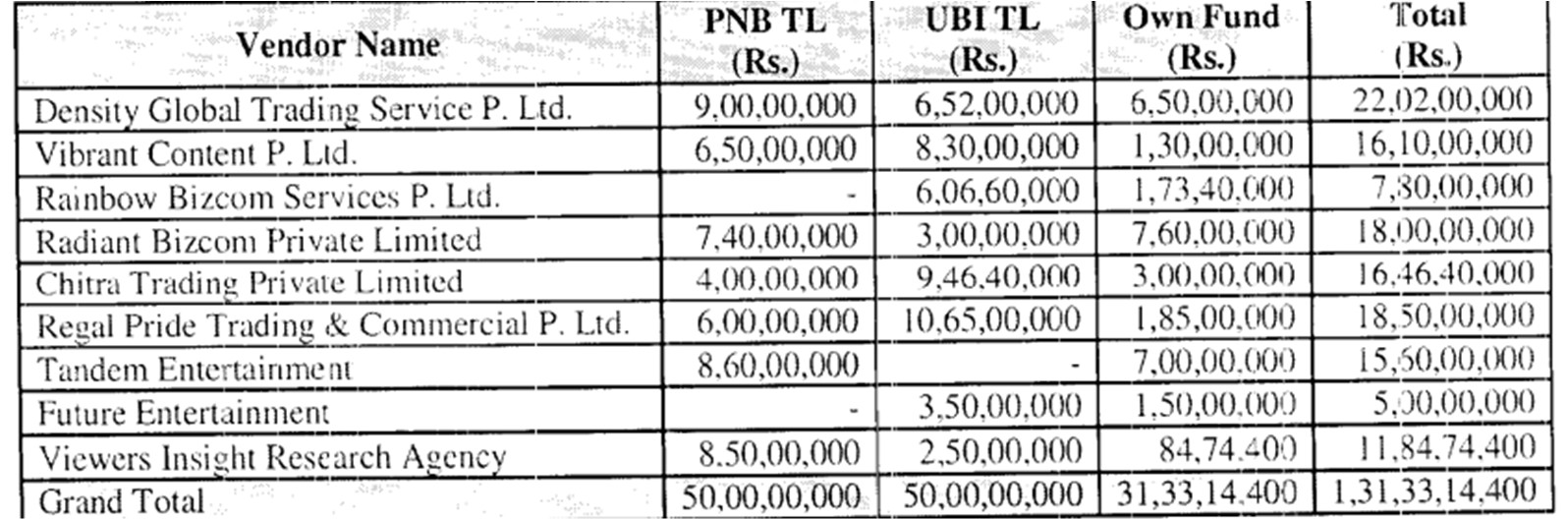
# 8. The Transaction Auditor has provided the party wise details of payments made by the Corporate Debtor –


# 9. The Respondent No. 1 and 2 filed affidavit in reply dated 02.08.2023 contesting the present application on following grounds –

a. The Applicant has filed composite application for avoidance under different sections and the same is not maintainable and has placed reliance upon the decision of Hon’ble Supreme Court in the case of Anuj Jain IRP for Jaypee Infratech Limited v. Axis Bank Limited, in Civil Appeal No. 8512 - 8527 of 2019.

b. The Transaction Auditor’s assertion that it has not physically verified the Business Commercial Rights & Television Programme Content is contrary to the statement of Applicant that he has verified the content and the detail provided is based on RP’s verification, thereby reflecting complete nonapplication of mind on the part of the Applicant insofar as the contents have been verified by the Applicant himself and recorded in the report as well.

c. The Applicant is demanding Rs. 133,14,85,175 (Rupees One Hundred Thirty Three Crore Fourteen Lakh Eighty Five Thousand One Hundred Seventy Five Only) from Respondent No. 1 and 2, which is the entire loan amount, even though Applicant is aware that the loan amount was utilised to purchase the content available with the Applicant.

d. The audit report itself in its audit observations states that “the valuation of inventory / intangible assets and its marketability / valuation holds the key to our conclusion. If these assets are able to generate the revenues which the Corporate Debtor has paid for (except variation on account of efflux of time) then the transactions although with related parties could be considered genuine.” Therefore, the entire basis of the Application is surmises. The fact that the contents purchased by the Corporate Debtor which are still intact and available holds a considerable value in the market and such transactions with vendors although with related parties will be considered as a genuine transaction. This should be considered that the decrease in prices can be affected by change of technology, covid and lapse of time.

e. The allegation pertaining to the price of pledged shares at the time of availing of loan was high but after the loan was sanctioned, the price of shares of SABTNL subsequently fell, is misconceived. The Applicant has failed to consider the sudden change in the policy decision which was placed in abeyance by Prasar Bharti due to administrative reasons which led to catastrophic effect on the Television Industry. Such factors including the impact of Demonetization etc. which were entirely outside the control of any Company. The Corporate Debtor incurred severe losses and was unable to service its dues towards the Bank. This also led to the decline in the price of shares of SABTNL and its other listed entities as the television industry was severely impacted.

f. The Respondent No. 3 to 12 have been regular vendors of Corporate Debtor with whom substantial transactions were done on arm’s length basis.

g. The Bank for their comfort and looking at the longstanding relations with Respondent No. 1 and the vendors had requested Respondent No. 1 to provide his personal guarantee. All the guarantees given by Respondent No. 1 was undertaken in his personal capacity and the same has no bearing on the business conducted by the Corporate Debtor with other Respondents.

h. It is a generally accepted trade practice in Media and entertainment content syndication business that routine day to  day business arrangements is executed on letterhead of the company but since the lenders requested the agreement to be executed on stamp paper hence the commercial contracts were executed on Rs. 100 stamp paper. The Bank is equally aware of such transactions as the loans were sanctioned and disbursed only after doing a thorough due diligence of these agreements and also through an external third-party agency.

i. The Respondent No. 1 has already agreed for OTS package with Punjab National Bank in respect of dues of the CD. Therefore, the allegation of fraud does not arise at all and also this conduct shows the bonafide intention of the Respondent.


# 10. Respondent No. 4 & & have filed the reply stating that they were regular vendors with whom substantial transactions were done on arm’s length basis; the personal guarantee was given by Respondent No. 1 in his personal capacity and on specific requirement of the lenders; the Respondents are third party entities who have no control over the shares of SABTNL and prices of shares are determined by external factors and market trends; Having common director does not make Respondent No. 4 & 7 as related party; Remedy against third party under Section 66 is not sustainable in view of Hon’ble Supreme Court decision in case of Gluckrich Capital (P) Ltd. v. State of W.B., 2023 SCC Online SC 1187; this tribunal cannot go into detailed questions of facts and law and independent proceedings before a civil or criminal court are the only respite available; and the transactions were carried out in ordinary course of business.


# 11. Heard the learned counsel for the applicant as well as the Respondent No.1 & 2 and 4 & 7 and perused the materials available on record. No other Respondent has filed any reply.


# 12. During the course of hearing, Counsel for the Applicant submitted that he is pressing prayer only in relation to Section 66 of the Code, accordingly, he didn’t make any arguments in relation to prayer ‘c’ pertaining to transactions with Respondent No. 12, which are claimed to be preferential in nature. In view of this, we proceed to examine this transaction in relation to Section 66 of the Code only.


# 13. The Respondent No. 1 & 2 have pleaded that the present Application is liable to be dismissed on the ground that the Applicant has filed composite application for avoidance under different sections and the same is not maintainable and relied upon the decision of Hon’ble Supreme Court in the case of Anuj Jain IRP for Jaypee Infratech Limited v. Axis Bank Limited, in Civil Appeal No. 8512 - 8527 of 2019 holding as under -

  • 29.1 The consequences of under valuation are contained in Sections 48 and 49. Per Section 49, if the undervalued transaction is referable to sub-section (2) of Section 45, the Adjudicating Authority may look at the intent to examine if such undervaluation was to defraud the creditors. On the other hand, the provisions of Section 66 related to fraudulent trading and wrongful trading entail the liabilities on the persons responsible therefor. We are not elaborating on all these aspects for being not necessary as the transactions in question are already held preferential and hence, the order for their avoidance is required to be approved; but it appears expedient to observe that the arena and scope of the requisite enquiries, to find if the transaction is undervalued or is intended to defraud the creditors or had been of wrongful/fraudulent trading are entirely different. Specific material facts are required to be pleaded if a transaction is sought to be brought under the mischief sought to be remedied by Sections 45/46/47 or Section 66 of the Code. As noticed, the scope of enquiry in relation to the questions as to whether a transaction is of giving preference at a relevant time, is entirely different. Hence, it would be expected of any resolution  professional to keep such requirements in view while making a motion to the Adjudicating Authority. [emphasis added]


# 14. The present application has been filed seeking relief in terms of Section 49 & 66 of the Code. While Section 49 deals with the undervalued transaction to defraud the creditors, the Section 66 deals with carrying on business with an intent to defraud the creditors or for any fraudulent purpose. The facts stated in the application and the conclusions drawn therefrom indicates that the applicant intended to make out a case in terms of Section 66 of the Code, as the material placed in the application does not provide any basis for holding the transactions, in question, as undervalued. The Hon’ble Supreme Court in the case of Anuj Jain (Supra) had explained that 

  • “Specific material facts are required to be pleaded if a transaction is sought to be brought under the mischief sought to be remedied by Sections 45/46/47 or Section 66 of the Code. As noticed, the scope of enquiry in relation to the questions as to whether a transaction is of giving preference at a relevant time, is entirely different. Hence, it would be expected of any resolution professional to keep such requirements in view while making a motion to the Adjudicating Authority. 29.2. In the present case, it is noticed that NCLT in its detailed and considered order essentially dealt with the features of the transaction in question being preferential at a relevant time but recorded combined findings on all these three aspects that the impugned transactions were preferential, undervalued and fraudulent. Appropriate it would have been to deal with all these aspects separately and distinctively”. 

In our considered view, the Hon’ble Supreme Court required that aspects of preferential, undervalued and fraudulent should be dealt with separately and distinctively. It cannot be said that a composite application shall not lie even if such application brings on record aspect of preferential, undervalued and fraudulent separately and distinctively, which we feel having been made out. The Applicant has elaborately pleaded how the Respondent No. 1 had carried out the business affairs of the Corporate Debtor. Even as regards transaction with Respondent No. 12, this application distinctly requires holding the said transaction as preferential and the facts and conclusions arising therefrom are separately culled out. Accordingly, we do not find any merit in this contention.


# 15. Section 66(1) of the Code provides that “If during the corporate insolvency resolution process or a liquidation process, it is found that any business of the corporate debtor has been carried on with intent to defraud creditors of the corporate debtor or for any fraudulent purpose, the Adjudicating Authority may on the application of the resolution professional pass an order that any persons who were knowingly parties to the carrying on of the business in such manner shall be liable to make such contributions to the assets of the corporate debtor as it may deem fit”.


# 16. In the present case, the Corporate Debtor obtained loan from PNB & UBI for operating two regional general entertainment channels namely Mauj Masti in Gujarati language and Seven Sisters Rainbow in Assamese language. The cost of project, as appraised by the lenders, contemplated purchase as well as own production of contents for these channels and the cost of purchase for each episode was estimated to be Rs. 1.00 lakh, while for production thereof, was estimated to be Rs. 2.40 lakh. The content rights were acquired after execution of an agreement with the vendors/suppliers on Rs. 100/- stamp paper and the price paid for such acquisition was exactly the same as was contemplated in the project report. The agreements, so executed, do not mention the details of TV serial episodes/rights including name of serial, producer/director name etc. and only states the number of episodes. The Transaction Auditor has pointed out that transfer agreements from its respective producers or negative right holder or licensors was not provided to them. It has further been pointed out by the Auditor that “As per Mott MacDonald TEV report the contents/episodes required for the channels should have been newly produced asll as syndicated and accordingly average acquisition cost per episode as mentioned under TEV report was Rs. 2.40 lakh for newly produced episode and Rs. 1.00 lakh for syndicated content. We have not been provided with the detailed break up for the same. However, the cost per episodes for acquiring the contents are exactly matching with the average cost per episodes as mentioned under TEV report i.e. Rs. 2.40 lakh / 1.00 lakh per episode”. The Transaction audit report further states that a sum of Rs. 5.00 crore was spent towards Brand Building and marketing, a sum of Rs. 11.85 crore for carriage fees and placement fees and a sum of Rs. 114.48 crores for Content rights of syndicated programs (8706 episodes). It further states that higher than 3963 episodes (as stipulated in TEV report) were procured for Gujarat Region and rest of episodes in language i.e. Hindi, Bhojpuri, English and Urdu, other than Gujarati are 4366, accordingly none of these episodes are in region specific language targeting state of North East India for other channel namely ‘Seven Sisters Rainbow’. Further, the proposed channel was General Entertainment channel (GEC) and not regional spiritual channel, however, most of the Guajarati content was religious in nature.


# 17. We have perused the explanation of the management as stated in the Transaction Audit Report, however, such explanation are evasive and generic in nature. The management has explained the failure of their project to the shift in policy decision of Prasar Bharti and subsequent switch over of viewership to OTT platforms. However, the Respondent No. 1 has relied upon a news clipping stated to be published on 13.4.2017 reporting “DD FreeDish poised to increase channel capacity to 250” and a notice dated 18.8.2017 putting 37th e-auction for DD free dish in abeyance. However, we note that the all the payments towards content acquisition were made to Respondent No. 3 to 9 during calendar year 2014 & 2015 only. Further, payment to Respondent No. 10 to 11 towards Brand Building and Promotion of these two channels were also made in same years. Accordingly, we are of considered view that the explanation offered by the management as recorded in the Transaction Auditor Report does not clarify why the content was acquired in the year 2015 itself when there was no news in relation increase in channel capacity and whether the Corporate Debtor had any other platform available at that time to exploit such content commercially after its purchase. Further, we note from the financial details of Respondent No. 3 to 8 placed in the transaction audit report that these Respondents were engaged in trading business from financial year 2013-14 which indicates that these Respondents were also not producer of any content.


# 18. In the case of M. Siddiq v. Suresh Das 2020 1 SCC 1, a Constitution Bench of Hon’ble Supreme Court has held that “The court in a civil trial applies a standard of proof governed by a preponderance of probabilities. This standard is also described sometimes as a balance of probability or the preponderance of the evidence”. In this context, if we weigh the defence of the Respondents in relation to the transaction, in question, we have no hesitation to say that these transactions were undertaken to defraud the creditors of the Corporate Debtor by mis-appropriating the loan availed from lenders under the garb of acquisition of content for launching of two new channels.


# 19. These facts are discernible from the Transaction Audit Report, which have formed the basis of satisfaction of the Applicant herein. Accordingly, we do not find any infirmity in the action of the Applicant seeking orders in terms of section 66 of the Code, as above facts clearly clearly lead to a conclusion that the business of the Corporate Debtor was carried with an intent to defraud creditors by creating a bogey of the acquisition of content to avail disbursement of sanctioned facilities. 


# 20. We note that the Respondent No. 2 was appointed as director on 28.5.2018 and the Corporate Debtor obtained loan from PNB & UBI in Financial year 201-16 and paid to the Respondents in that year towards acquisition of content. Accordingly, we are of considered view that no action lie against the Respondent No. 2 in relation to alleged mis-utilisation of the loan obtained from the Bank.


# 21. Respondent No. 4 & 7 have relied upon the decision in case of Gluckrich Capital (P) Ltd. (Supra) to contend that no action lies against the third party. In the present case, Respondent No. 4 & 7 are stated to be related parties on the premise that Respondent No. 1 stood as guarantor to the credit facilities enjoyed by Respondent No. 4, whose holding company also holds shares in one of Group company of Respondent No. 1. Respondent No. 7 & Respondent No. 4 are stated to have common director and have its registered office at the same address. These facts lead us to a conclusion that Respondent No. 4 & 7 can not held to be third parties, hence an order in terms of Section 66 can be passed against them, as held by Hon’ble NCLAT in case of Royal India Corporation Ltd. v. Mr. Nandkishor Vishnupant Deshpande (RP) and Ors. (2024) ibclaw.in 304 NCLAT after considering the decision of Hon’ble Supreme Court in case of Gluckrich Capital (P) Ltd. (Supra). Further, Respondent No. 3, 5, 6 & 8 can also be said to be related person based on the their connection arising from provision of guarantee by Respondent No. 1 to the credit facilities enjoyed by them or they being shareholder in one of the group company holding more than 2% of the shares, even though not strictly as per definition of term contained in the Code, accordingly, it can not be said that no order in terms of section 66 of the Code can be passed against them. 


# 22. The Applicant has not made out any case of relatedness  of Respondent No. 9 to 11 in any manner. Accordingly, in view of decision of Hon’ble Supreme Court in case of Gluckrich Capital P Ltd (Supra), no order is called for against them.


# 23. The Respondent No. 1 & 2 also placed reliance on decision by coordinate Bench of this Tribunal i.e. NCLT, Mumbai Bench in Venkatesan Sankaranarayanan, RP for RTIL Ltd v Nitin Shambhukumar Kasliwal holding that mere possibility or suspicion of fraud, without relevant material details to substantiate the same, cannot form the basis of an application under section 66 of the IBC. However, for the reasons stated above, we are of the considered view that facts stated in the Transaction Audit Report and the conclusions drawn therefrom cannot be said to be falling in realm of possibility or suspicion.


# 24. Having said so, we note that the Respondent No. 1 is a guarantor to the credit facilities extended to the Corporate Debtor, which is fundamental basis of the present application. Section 66 of the Code makes any persons who were knowingly parties to the carrying on of the business liable to make such contributions to the assets of the corporate debtor as this Tribunal decides. We note that the Respondent No. 1 & 2 in their reply have stated that the debt owed by the Corporate Debtor to PNB and UBI has been settled under OTS arrangement, though no evidence to this effect has been placed on record. Nonetheless, the Respondent No. 1 is liable to the debt remaining due from the Corporate Debtor in his personal capacity as guarantor. On perusal of the CoC meeting minutes, we note that there are couple of operational creditors, apart from PNB & UBI, have filed their claim. Any excess recovery beyond the claim of creditor shall enure to the benefit of shareholders, who are Respondent No. 1 and deceased Guatam Adhikari here and this could not have been intent of provisions of section 66 of the Code to benefit the persons from the proceeds arising from their own wrongdoings. Accordingly, we direct the Respondent No. 1, & 3 to 8 to make contributions not exceeding Rs.133,14,85,175 (Rupees One Hundred Thirty Three Crore Fourteen Lakh Eighty Five Thousand One Hundred Seventy Five Only, either individually or jointly to the Corporate Debtor for an amount, which remains unpaid to its creditors as on date. The Applicant shall quantify such amount and intimate to these Respondents within 15 days. The amount so ordered shall be paid within 30 days after receipt of communication from the applicant. It is clarified that the applicant shall not recover amounts in totality from these Respondent exceeding the amounts remaining unpaid to its creditors as on date.


# 25. In view of the above, IA 1464 of 2021 is partly allowed and disposed of accordingly.

----------------------------------------

Disclaimer:

The sole purpose of this post is to create awareness on the "IBC - Case Law" and to provide synopsis of the concerned case law, must not be used as a guide for taking or recommending any action or decision. A reader must refer to the full citation of the order & do one's own research and seek professional advice if he intends to take any action or decision in the matters covered in this post.